Public sample report: This public sample uses illustrative HarborPoint Foundation Repair data. Real customer reports use the customer website and approved public or owner-provided evidence.
Tool & Tally · Turn Visitors Into Customers
Level 3: Monthly Checkup
A Month 1 starting point and recurring checkup structure for HarborPoint Foundation Repair: call/book/contact recheck, local findability snapshot, tracked searches, competitor movement, review/rating freshness, service-area changes, issue tracker, and monthly top actions.
Paid Customer ReportHarborPoint Foundation Repair2026-05-15
Scope and safety: Work basis: public pages were checked from visible website evidence only. No forms were submitted, no phone call was made, no chat was opened, and no outreach was sent. This report does not guarantee calls, bookings, sales, revenue, rankings, legal disability-access compliance, review removal, rating improvement, or reputation repair. Findings are owner-facing plain-English notes based on what was visible at check time.
Package ladder at a glance
Level 1Website Checkupfirst-screen clarity, call/book/contact findability, mobile friction, confidence details, service-area clarity, screenshot evidence, and prioritized fixes.
Level 2Detailed Website + Google/Search Analysisdeeper visitor journey, Google/local search, Google Business/local profile observations, competitor/reference comparison, Customer Voice Snapshot, Missed Opportunity check, and ranked fixes.
Level 2Fix Plan Add-onwebsite-provider handoff with exact wording, layout instructions, owner tasks, website-person tasks, acceptance checks, and retest steps.
Level 3Monthly Checkupsame-page rechecks, local findability snapshot, tracked searches, competitor movement, review/rating freshness watch, action tracker, and monthly priorities.
Monthly starting point dashboard
Level 3 turns the same checks into a recurring monthly starting point: what changed, what stayed stuck, and what to do next.
Best visible strength
Trust
StrongBrand, service fit, phone/contact options, and visible reassurance are present.
Main friction
Location check
ClarifyThe visitor is asked for location before the page clearly explains what happens next.
Mobile issue
Trust details
Move upConfidence details need to sit closer to the first mobile action.
Next decision
Main button
ActionableChoose the main button first, then make other options less distracting.
First-screen clarity
82/100 Strong
Main action clarity
56/100 Improve
Mobile confidence placement
52/100 Improve
Service-area clarity
74/100 Good
Search/local basics
66/100 Watch
Tracking readiness
54/100 Starting point
Score boundary: These are report-quality plain-English scores only. They are not public rankings, Google/search rankings, lead predictions, booking predictions, revenue forecasts, legal/easy-to-use/readability conclusions, or business-result guarantees.
Monthly scorecard
Owner scorecard: The scorecard makes the report easy to scan before reading the details. Scores are plain-English only.
First-screen clarity
82/100 Strong
Main action clarity
56/100 Improve
Mobile confidence placement
52/100 Improve
Service-area clarity
74/100 Good
Search/local basics
66/100 Watch
Tracking readiness
54/100 Starting point
| Area | Current finding | Owner meaning | Status |
|---|
| First screen | Service, location/request, phone/contact path, and reassurance are visible. | Good foundation. | Strong |
| Primary action | Several actions compete for attention. | One needs to become the clear first step. | Improve |
| Mobile confidence | Review/rating detail is partly clipped or lower than the first action. | Move trust detail closer to the decision point. | Move up |
What we found and what to do next
What we found: Monthly scorecard has enough public evidence for a completed owner-facing recommendation. The finding below gives the current starting point, owner action, website-person task, verification check, and evidence limit.
- Month 1 starting point: Monthly rule: keep Month 1 as the starting point, compare the same pages and device views next month, and separate what changed from what remains open.
- Monthly rule: Monthly rule: keep Month 1 as the starting point, compare the same pages and device views next month, and separate what changed from what remains open.
- Owner action: Owner action: approve the main action, approved wording, and retest priority before the website person changes the public page.
- Acceptance check: How to verify: the same public-page view shows one primary action, a clear next-step explanation, source-safe reassurance, and no new clutter covering the decision.
Monthly dashboard
Month 1 starting point
Capture desktop/mobile homepage, services page, action path, search/local snapshot, competitor/reference set, and issue tracker.
Month 2 compare
Use the same pages, device/location notes, and visible action criteria so movement is not guessed.
Owner decision
Close only fixed items with screenshot evidence. Keep tracking open items until verified.
1
Primary action
Make Book Now / location request the obvious first step, then visually reduce secondary choices.
High
2
What happens next
Add one helper line before location entry or booking start.
High
3
Mobile confidence
Move one source-safe rating/review or guarantee line near the first mobile action.
Medium
4
Service-area fit
Make local foundation repair service and local availability clear before deep scrolling.
Medium
5
Monthly recheck
Recapture the same pages and compare scores after edits.
Starting point
| Monthly item | Starting point | Next check rule |
|---|
| Broken button/form/booking check | Visible buttons and location/request are present; no forms submitted. | Run approved no-submit checks only. |
| Seasonal message recommendation | Use practical foundation repair seasonality where relevant. | No scare copy or guaranteed outcomes. |
| Review/rating freshness | Use source-dated public or owner-approved cues only. | Update date/count references before reuse. |
What we found and what to do next
What we found: Monthly dashboard has enough public evidence for a completed owner-facing recommendation. The finding below gives the current starting point, owner action, website-person task, verification check, and evidence limit.
- Month 1 starting point: Monthly rule: keep Month 1 as the starting point, compare the same pages and device views next month, and separate what changed from what remains open.
- Monthly rule: Monthly rule: keep Month 1 as the starting point, compare the same pages and device views next month, and separate what changed from what remains open.
- Owner action: Owner action: approve the main action, approved wording, and retest priority before the website person changes the public page.
- Acceptance check: How to verify: the same public-page view shows one primary action, a clear next-step explanation, source-safe reassurance, and no new clutter covering the decision.
call/book/contact recheck
Call/book/contact findability: The visible site gives visitors multiple action routes, which is useful, but the routes need a clearer hierarchy.
1. LandVisitor sees foundation repair brand, location/request option, phone/contact path, and service promise.
2. TrustVisitor looks for rating/review, punctuality, guarantee, or local trust details before acting.
3. ChooseVisitor decides between Call, Book Now, location entry, services page, or help.
4. StartVisitor enters location or starts booking, but needs to know what happens next.
5. RecheckOwner verifies the same desktop/mobile screens after changes.
Keep
- Visible phone/contact path.
- Book Now / local service entry.
- Service page connection.
Fix
- Explain what happens after location entry.
- Clarify whether the visitor is booking, confirming location, or requesting help.
- Reduce competing mobile action weight.
What we found and what to do next
What we found: Website call/book/contact recheck has enough public evidence for a completed owner-facing recommendation. The finding below gives the current starting point, owner action, website-person task, verification check, and evidence limit.
- Month 1 starting point: Monthly rule: keep Month 1 as the starting point, compare the same pages and device views next month, and separate what changed from what remains open.
- Monthly rule: Monthly rule: keep Month 1 as the starting point, compare the same pages and device views next month, and separate what changed from what remains open.
- Owner action: Owner action: approve the main action, approved wording, and retest priority before the website person changes the public page.
- Acceptance check: How to verify: the same public-page view shows one primary action, a clear next-step explanation, source-safe reassurance, and no new clutter covering the decision.
Broken button
Call/book/contact findability: The visible site gives visitors multiple action routes, which is useful, but the routes need a clearer hierarchy.
1. LandVisitor sees foundation repair brand, location/request option, phone/contact path, and service promise.
2. TrustVisitor looks for rating/review, punctuality, guarantee, or local trust details before acting.
3. ChooseVisitor decides between Call, Book Now, location entry, services page, or help.
4. StartVisitor enters location or starts booking, but needs to know what happens next.
5. RecheckOwner verifies the same desktop/mobile screens after changes.
Keep
- Visible phone/contact path.
- Book Now / local service entry.
- Service page connection.
Fix
- Explain what happens after location entry.
- Clarify whether the visitor is booking, confirming location, or requesting help.
- Reduce competing mobile action weight.
What we found and what to do next
What we found: Broken button/form/booking check has enough public evidence for a completed owner-facing recommendation. The finding below gives the current starting point, owner action, website-person task, verification check, and evidence limit.
- Month 1 starting point: Monthly rule: keep Month 1 as the starting point, compare the same pages and device views next month, and separate what changed from what remains open.
- Monthly rule: Monthly rule: keep Month 1 as the starting point, compare the same pages and device views next month, and separate what changed from what remains open.
- Owner action: Owner action: approve the main action, approved wording, and retest priority before the website person changes the public page.
- Acceptance check: How to verify: the same public-page view shows one primary action, a clear next-step explanation, source-safe reassurance, and no new clutter covering the decision.
Search/local findability
Search and local presence: Public page wording supports foundation repair, crawlspace support, settling/crack inspection, and local service-area context. City/service pages should use clearer foundation repair + service-area titles, descriptions, headings, and plain homeowner FAQ wording. No ranking, traffic, call, form, or revenue guarantee is made.
Search/local findability snapshot
This is a practical owner snapshot, not a ranking claim. It shows whether the website gives Google and visitors enough plain service/local context to understand the business.
Foundation repair service clarity
84 Strong
Local service-area clarity
68 Watch
Google Business listing match
60 Check
Behind-the-scenes search basics readiness
64 Verify
Monthly tracking repeatability
58 Starting point
| Tracked search area | What to record monthly | Owner meaning |
|---|
| Foundation repair inspection + city/service area | Date, device, location note, visible page fit, and top reference pages. | Shows whether urgent-service wording stays clear. |
| Foundation crack repair + city/service area | Visible service-page title, heading, reassurance, and booking explanation. | Shows whether service-specific pages answer high-intent questions. |
| Crawlspace moisture repair / local foundation repair | Service-area wording and next-step clarity. | Shows whether local intent connects to a clear action. |
Google Business/local profile observations: The website has service/category and location signals that need to align with Google Business listing categories, services, hours, booking link, phone, photos, and review response rhythm. Private Google Business listing insights were not accessed.
What we found and what to do next
What we found: Local search findability snapshot has enough public evidence for a completed owner-facing recommendation. The finding below gives the current starting point, owner action, website-person task, verification check, and evidence limit.
- Month 1 starting point: Monthly rule: keep Month 1 as the starting point, compare the same pages and device views next month, and separate what changed from what remains open.
- Monthly rule: Monthly rule: keep Month 1 as the starting point, compare the same pages and device views next month, and separate what changed from what remains open.
- Owner action: Owner action: approve the main action, approved wording, and retest priority before the website person changes the public page.
- Acceptance check: How to verify: the same public-page view shows one primary action, a clear next-step explanation, source-safe reassurance, and no new clutter covering the decision.
Tracked searches
Search and local presence: Public page wording supports foundation repair, crawlspace support, settling/crack inspection, and local service-area context. City/service pages should use clearer foundation repair + service-area titles, descriptions, headings, and plain homeowner FAQ wording. No ranking, traffic, call, form, or revenue guarantee is made.
Search/local findability snapshot
This is a practical owner snapshot, not a ranking claim. It shows whether the website gives Google and visitors enough plain service/local context to understand the business.
Foundation repair service clarity
84 Strong
Local service-area clarity
68 Watch
Google Business listing match
60 Check
Behind-the-scenes search basics readiness
64 Verify
Monthly tracking repeatability
58 Starting point
| Tracked search area | What to record monthly | Owner meaning |
|---|
| Foundation repair inspection + city/service area | Date, device, location note, visible page fit, and top reference pages. | Shows whether urgent-service wording stays clear. |
| Foundation crack repair + city/service area | Visible service-page title, heading, reassurance, and booking explanation. | Shows whether service-specific pages answer high-intent questions. |
| Crawlspace moisture repair / local foundation repair | Service-area wording and next-step clarity. | Shows whether local intent connects to a clear action. |
Google Business/local profile observations: The website has service/category and location signals that need to align with Google Business listing categories, services, hours, booking link, phone, photos, and review response rhythm. Private Google Business listing insights were not accessed.
What we found and what to do next
What we found: Tracked searches with date/location/device has enough public evidence for a completed owner-facing recommendation. The finding below gives the current starting point, owner action, website-person task, verification check, and evidence limit.
- Search phrase: Search/local check: keep the service name, page title or description, main heading, service-area wording, and repeatable search notes aligned so people and search engines see the same plain story.
- Date, location, and device: Tracking note: record the search phrase, date, location, and device so the next check repeats the same method instead of mixing unrelated snapshots.
- Owner meaning: Why it matters: make the first visitor action clearer, keep the useful trust details, and avoid turning search or design notes into technical chores.
- No ranking guarantee: Evidence limit: this uses visible public-page evidence only; no forms were submitted, no phone call or chat was opened, no outreach was sent, and no calls, bookings, sales, revenue, rankings, rating improvement, or legal result is promised.
- Owner action: Owner action: approve the main action, approved wording, and retest priority before the website person changes the public page.
- Acceptance check: How to verify: the same public-page view shows one primary action, a clear next-step explanation, source-safe reassurance, and no new clutter covering the decision.
Competitor comparison chart
Competitor/reference pattern chart
The useful comparison is not who wins. It is what competing pages make easier for a visitor and what HarborPoint Foundation Repair should protect or improve.
Market pattern
Fast
Competitor/reference pages often make urgent foundation repair and service choices visible quickly.
Client strength
Brand
HarborPoint Foundation Repair has visible brand reassurance and contact/request actions.
Client gap
Explain
The location/request step needs clearer wording before the visitor commits.
Evidence rule
Clean
Blocked references are excluded, not hidden inside the report.
Competitor / reference website
What they make easier
What HarborPoint Foundation Repair already has
Client-side opportunity
Local Foundation Specialist
Direct foundation repair service framing and urgent-service clarity.
Visible service category, contact/request step, and credibility cues.
Make the foundation repair service path feel obvious before location entry.
Crawlspace Moisture Contractor
Broad home-service positioning with direct action.
Visible service category, contact/request step, and credibility cues.
Use short service-area and what happens next copy near the first action.
Regional Foundation Brand
Simple visitor confidence pattern and visual service framing.
Visible service category, contact/request step, and credibility cues.
Move one source-safe confidence line closer to mobile booking.
High-Review Local Contractor
Direct foundation repair service framing and urgent-service clarity.
Visible service category, contact/request step, and credibility cues.
Make the foundation repair service path feel obvious before location entry.
Urgent Repair Reference
Broad home-service positioning with direct action.
Visible service category, contact/request step, and credibility cues.
Use short service-area and what happens next copy near the first action.
Source note: only accessible references were used. The report does not fill space with bad screenshots.
What we found and what to do next
What we found: Competitor movement/watch has enough public evidence for a completed owner-facing recommendation. The finding below gives the current starting point, owner action, website-person task, verification check, and evidence limit.
Completed competitor comparison: Accessible references were reviewed for emergency wording, appointment language, local service cues, mobile button order, reassurance placement, and blocked-source exclusions. The useful takeaway is the clarity pattern the owner can adopt, not a scoreboard.
- Named reference rows: Competitor takeaways: compare only accessible competitor or market examples for clarity patterns, name any usable references, and exclude blocked sources rather than filling gaps with unsupported claims.
- Client-side opportunity: Competitor takeaways: compare only accessible competitor or market examples for clarity patterns, name any usable references, and exclude blocked sources rather than filling gaps with unsupported claims.
- Blocked source boundary: Evidence limit: this uses visible public-page evidence only; no forms were submitted, no phone call or chat was opened, no outreach was sent, and no calls, bookings, sales, revenue, rankings, rating improvement, or legal result is promised.
- Owner action: Owner action: approve the main action, approved wording, and retest priority before the website person changes the public page.
- Acceptance check: How to verify: the same public-page view shows one primary action, a clear next-step explanation, source-safe reassurance, and no new clutter covering the decision.
Level 3 Monthly Customer Voice Snapshot Tracker
Customer Voice Analysis: public review themes and owner actions
Public review signals point to two practical website moves: repeat believable positives near the call/book decision and reduce hesitation with clearer request-step or follow-up wording. This is not reputation repair, review removal, rating improvement, or a promise of calls, bookings, rankings, sales, or revenue.
Sources checked
3
Illustrative 48-row review-theme set for the public sample; no live review URLs used.
Usable signals
48
Clean public pages and snippets gave usable customer-language clues.
Praise themes
5
Use repeated positives near the call/book decision.
Friction themes
5
Reduce repeated concerns with clearer wording and follow-up expectations.
Level 3 Monthly Customer Voice tracker
| Monthly item | Month 1 starting point | Next month check | Owner action if it changes |
|---|
| Praise themes | 5 praise categories counted from public-source signals. | Compare the same source types and any owner-approved export rows. | Move repeated praise into the highest-traffic call/book/service pages. |
| Friction themes | 5 friction categories counted from public-source signals. | Watch price, scheduling, follow-up, and unresolved-issue signals. | Add clearer expectation wording or follow-up paths where concern starts. |
| Source coverage | 48 usable public/source signals in this run. | Add owner-approved Google/Yelp/Birdeye exports when available. | Only call movement real when the same source rules are used month to month. |
Current counted themes
| Feedback type | Counted signal | Monthly recommendation |
|---|
| clear explanation before repair options
| 31 public-source signal mentions | Place inspection-first reassurance beside the first request button and final form button. |
| professional crew and respectful inspection
| 26 public-source signal mentions | Use one approved professionalism/crew confidence line near the request step. |
| clean work area and careful walkthrough
| 21 public-source signal mentions | Add a short cleanup/walkthrough expectation line after the inspection-step explanation. |
| on-time arrival or clear arrival window
| 19 public-source signal mentions | Explain callback and arrival-window expectations before submission. |
| fair process with no pressure
| 16 public-source signal mentions | Say requesting an inspection is not repair approval. |
| scheduling delay or uncertain appointment timing
| 12 public-source signal mentions | Add what happens next wording and confirmation timing near the form. |
| price anxiety before inspection
| 10 public-source signal mentions | Use careful expectation wording without promising price outcomes. |
| callback confusion after request
| 9 public-source signal mentions | State whether the team calls, emails, schedules, or confirms before arrival. |
| photo upload or form uncertainty
| 7 public-source signal mentions | Mark photos optional before the upload field. |
| scope warranty or financing questions
| 6 public-source signal mentions | Use conservative owner-approved wording and avoid warranty, financing, insurance, or engineering promises. |
Review sources used
| Source | Status | URL |
|---|
| Owner-approved review export sample | used | |
| Website review snippet sample | used | |
| Local profile snippet sample | used | |
Coverage boundary: Illustrative review themes only; no live review URLs are presented. Real customer reports use owner-approved review exports, official platform/API rows where available, or clean public snippets/screenshots with source dates. Deeper coverage should use owner-approved review exports, official platform APIs where available, or customer-provided screenshots/CSV rows.
What we found and what to do next
What we found: Level 3 Customer Voice tracker has enough public evidence for a completed owner-facing recommendation. The finding below gives the current starting point, owner action, website-person task, verification check, and evidence limit.
- Source table: Evidence limit: this uses visible public-page evidence only; no forms were submitted, no phone call or chat was opened, no outreach was sent, and no calls, bookings, sales, revenue, rankings, rating improvement, or legal result is promised.
- Praise or friction themes: Customer Voice finding: use the public praise and friction themes that were actually found to place believable reassurance or expectation wording near the action.
- Owner actions: Owner action: approve the main action, approved wording, and retest priority before the website person changes the public page.
- Coverage boundary: Evidence limit: this uses visible public-page evidence only; no forms were submitted, no phone call or chat was opened, no outreach was sent, and no calls, bookings, sales, revenue, rankings, rating improvement, or legal result is promised.
- Owner action: Owner action: approve the main action, approved wording, and retest priority before the website person changes the public page.
- Acceptance check: How to verify: the same public-page view shows one primary action, a clear next-step explanation, source-safe reassurance, and no new clutter covering the decision.
review/rating freshness
Customer Voice Analysis: public review themes and owner actions
Public review signals point to two practical website moves: repeat believable positives near the call/book decision and reduce hesitation with clearer request-step or follow-up wording. This is not reputation repair, review removal, rating improvement, or a promise of calls, bookings, rankings, sales, or revenue.
Sources checked
3
Illustrative 48-row review-theme set for the public sample; no live review URLs used.
Usable signals
48
Clean public pages and snippets gave usable customer-language clues.
Praise themes
5
Use repeated positives near the call/book decision.
Friction themes
5
Reduce repeated concerns with clearer wording and follow-up expectations.
Level 3 Monthly Customer Voice tracker
| Monthly item | Month 1 starting point | Next month check | Owner action if it changes |
|---|
| Praise themes | 5 praise categories counted from public-source signals. | Compare the same source types and any owner-approved export rows. | Move repeated praise into the highest-traffic call/book/service pages. |
| Friction themes | 5 friction categories counted from public-source signals. | Watch price, scheduling, follow-up, and unresolved-issue signals. | Add clearer expectation wording or follow-up paths where concern starts. |
| Source coverage | 48 usable public/source signals in this run. | Add owner-approved Google/Yelp/Birdeye exports when available. | Only call movement real when the same source rules are used month to month. |
Current counted themes
| Feedback type | Counted signal | Monthly recommendation |
|---|
| clear explanation before repair options
| 31 public-source signal mentions | Place inspection-first reassurance beside the first request button and final form button. |
| professional crew and respectful inspection
| 26 public-source signal mentions | Use one approved professionalism/crew confidence line near the request step. |
| clean work area and careful walkthrough
| 21 public-source signal mentions | Add a short cleanup/walkthrough expectation line after the inspection-step explanation. |
| on-time arrival or clear arrival window
| 19 public-source signal mentions | Explain callback and arrival-window expectations before submission. |
| fair process with no pressure
| 16 public-source signal mentions | Say requesting an inspection is not repair approval. |
| scheduling delay or uncertain appointment timing
| 12 public-source signal mentions | Add what happens next wording and confirmation timing near the form. |
| price anxiety before inspection
| 10 public-source signal mentions | Use careful expectation wording without promising price outcomes. |
| callback confusion after request
| 9 public-source signal mentions | State whether the team calls, emails, schedules, or confirms before arrival. |
| photo upload or form uncertainty
| 7 public-source signal mentions | Mark photos optional before the upload field. |
| scope warranty or financing questions
| 6 public-source signal mentions | Use conservative owner-approved wording and avoid warranty, financing, insurance, or engineering promises. |
Review sources used
| Source | Status | URL |
|---|
| Owner-approved review export sample | used | |
| Website review snippet sample | used | |
| Local profile snippet sample | used | |
Coverage boundary: Illustrative review themes only; no live review URLs are presented. Real customer reports use owner-approved review exports, official platform/API rows where available, or clean public snippets/screenshots with source dates. Deeper coverage should use owner-approved review exports, official platform APIs where available, or customer-provided screenshots/CSV rows.
What we found and what to do next
What we found: Public review/rating freshness watch has enough public evidence for a completed owner-facing recommendation. The finding below gives the current starting point, owner action, website-person task, verification check, and evidence limit.
- Source table: Evidence limit: this uses visible public-page evidence only; no forms were submitted, no phone call or chat was opened, no outreach was sent, and no calls, bookings, sales, revenue, rankings, rating improvement, or legal result is promised.
- Praise or friction themes: Customer Voice finding: use the public praise and friction themes that were actually found to place believable reassurance or expectation wording near the action.
- Owner actions: Owner action: approve the main action, approved wording, and retest priority before the website person changes the public page.
- Coverage boundary: Evidence limit: this uses visible public-page evidence only; no forms were submitted, no phone call or chat was opened, no outreach was sent, and no calls, bookings, sales, revenue, rankings, rating improvement, or legal result is promised.
- Owner action: Owner action: approve the main action, approved wording, and retest priority before the website person changes the public page.
- Acceptance check: How to verify: the same public-page view shows one primary action, a clear next-step explanation, source-safe reassurance, and no new clutter covering the decision.
service-area
Search and local presence: Public page wording supports foundation repair, crawlspace support, settling/crack inspection, and local service-area context. City/service pages should use clearer foundation repair + service-area titles, descriptions, headings, and plain homeowner FAQ wording. No ranking, traffic, call, form, or revenue guarantee is made.
Search/local findability snapshot
This is a practical owner snapshot, not a ranking claim. It shows whether the website gives Google and visitors enough plain service/local context to understand the business.
Foundation repair service clarity
84 Strong
Local service-area clarity
68 Watch
Google Business listing match
60 Check
Behind-the-scenes search basics readiness
64 Verify
Monthly tracking repeatability
58 Starting point
| Tracked search area | What to record monthly | Owner meaning |
|---|
| Foundation repair inspection + city/service area | Date, device, location note, visible page fit, and top reference pages. | Shows whether urgent-service wording stays clear. |
| Foundation crack repair + city/service area | Visible service-page title, heading, reassurance, and booking explanation. | Shows whether service-specific pages answer high-intent questions. |
| Crawlspace moisture repair / local foundation repair | Service-area wording and next-step clarity. | Shows whether local intent connects to a clear action. |
Google Business/local profile observations: The website has service/category and location signals that need to align with Google Business listing categories, services, hours, booking link, phone, photos, and review response rhythm. Private Google Business listing insights were not accessed.
What we found and what to do next
What we found: Service-area/service-page gap changes has enough public evidence for a completed owner-facing recommendation. The finding below gives the current starting point, owner action, website-person task, verification check, and evidence limit.
- Month 1 starting point: Monthly rule: keep Month 1 as the starting point, compare the same pages and device views next month, and separate what changed from what remains open.
- Monthly rule: Monthly rule: keep Month 1 as the starting point, compare the same pages and device views next month, and separate what changed from what remains open.
- Owner action: Owner action: approve the main action, approved wording, and retest priority before the website person changes the public page.
- Acceptance check: How to verify: the same public-page view shows one primary action, a clear next-step explanation, source-safe reassurance, and no new clutter covering the decision.
speed/mobile/easy-to-use/readability
Desktop/mobile strength
The homepage presents foundation inspection, repair planning, crawlspace support, a phone/contact path, a visible inspection request action, local service-area reassurance, and review/rating confidence cues. The main issue is that strongest reassurance appears after the first mobile decision point.
Mobile usability issue
The mobile first screen has usable service context, but the customer confidence details, photo-upload reassurance, and what happens next wording need to sit closer to the first action. This is a practical mobile/readability note, not a legal accessibility conclusion.
| Practical check | Finding | Website-person action |
|---|
| Tap/action clarity | Call, Book Now, location/update-location, and help options are visible. | Make one action primary and keep secondary options lighter. |
| Readability | Brand and service context are readable, but mobile density matters. | Check smaller labels, sticky controls, and clipped review/rating text. |
| Easy-to-read/mobile-use | This is a friction check, not legal certification. | Verify contrast, focus states, tap targets, and no covered decision copy. |
What we found and what to do next
What we found: Speed/mobile/easy-to-use/readability backslide basics has enough public evidence for a completed owner-facing recommendation. The finding below gives the current starting point, owner action, website-person task, verification check, and evidence limit.
- Month 1 starting point: Monthly rule: keep Month 1 as the starting point, compare the same pages and device views next month, and separate what changed from what remains open.
- Monthly rule: Monthly rule: keep Month 1 as the starting point, compare the same pages and device views next month, and separate what changed from what remains open.
- Owner action: Owner action: approve the main action, approved wording, and retest priority before the website person changes the public page.
- Acceptance check: How to verify: the same public-page view shows one primary action, a clear next-step explanation, source-safe reassurance, and no new clutter covering the decision.
Seasonal message
Month 1 starting point
Capture desktop/mobile homepage, services page, action path, search/local snapshot, competitor/reference set, and issue tracker.
Month 2 compare
Use the same pages, device/location notes, and visible action criteria so movement is not guessed.
Owner decision
Close only fixed items with screenshot evidence. Keep tracking open items until verified.
1
Primary action
Make Book Now / location request the obvious first step, then visually reduce secondary choices.
High
2
What happens next
Add one helper line before location entry or booking start.
High
3
Mobile confidence
Move one source-safe rating/review or guarantee line near the first mobile action.
Medium
4
Service-area fit
Make local foundation repair service and local availability clear before deep scrolling.
Medium
5
Monthly recheck
Recapture the same pages and compare scores after edits.
Starting point
| Monthly item | Starting point | Next check rule |
|---|
| Broken button/form/booking check | Visible buttons and location/request are present; no forms submitted. | Run approved no-submit checks only. |
| Seasonal message recommendation | Use practical foundation repair seasonality where relevant. | No scare copy or guaranteed outcomes. |
| Review/rating freshness | Use source-dated public or owner-approved cues only. | Update date/count references before reuse. |
What we found and what to do next
What we found: Seasonal message recommendation has enough public evidence for a completed owner-facing recommendation. The finding below gives the current starting point, owner action, website-person task, verification check, and evidence limit.
- Month 1 starting point: Monthly rule: keep Month 1 as the starting point, compare the same pages and device views next month, and separate what changed from what remains open.
- Monthly rule: Monthly rule: keep Month 1 as the starting point, compare the same pages and device views next month, and separate what changed from what remains open.
- Owner action: Owner action: approve the main action, approved wording, and retest priority before the website person changes the public page.
- Acceptance check: How to verify: the same public-page view shows one primary action, a clear next-step explanation, source-safe reassurance, and no new clutter covering the decision.
Issue/action tracker
Month 1 starting point
Capture desktop/mobile homepage, services page, action path, search/local snapshot, competitor/reference set, and issue tracker.
Month 2 compare
Use the same pages, device/location notes, and visible action criteria so movement is not guessed.
Owner decision
Close only fixed items with screenshot evidence. Keep tracking open items until verified.
1
Primary action
Make Book Now / location request the obvious first step, then visually reduce secondary choices.
High
2
What happens next
Add one helper line before location entry or booking start.
High
3
Mobile confidence
Move one source-safe rating/review or guarantee line near the first mobile action.
Medium
4
Service-area fit
Make local foundation repair service and local availability clear before deep scrolling.
Medium
5
Monthly recheck
Recapture the same pages and compare scores after edits.
Starting point
| Monthly item | Starting point | Next check rule |
|---|
| Broken button/form/booking check | Visible buttons and location/request are present; no forms submitted. | Run approved no-submit checks only. |
| Seasonal message recommendation | Use practical foundation repair seasonality where relevant. | No scare copy or guaranteed outcomes. |
| Review/rating freshness | Use source-dated public or owner-approved cues only. | Update date/count references before reuse. |
What we found and what to do next
What we found: Issue/action tracker has enough public evidence for a completed owner-facing recommendation. The finding below gives the current starting point, owner action, website-person task, verification check, and evidence limit.
- Month 1 starting point: Monthly rule: keep Month 1 as the starting point, compare the same pages and device views next month, and separate what changed from what remains open.
- Monthly rule: Monthly rule: keep Month 1 as the starting point, compare the same pages and device views next month, and separate what changed from what remains open.
- Owner action: Owner action: approve the main action, approved wording, and retest priority before the website person changes the public page.
- Acceptance check: How to verify: the same public-page view shows one primary action, a clear next-step explanation, source-safe reassurance, and no new clutter covering the decision.
Monthly top 3
Ranked owner fixes: These are the top changes because they improve clarity before a visitor calls, books, enters location, or asks for help.
1
Primary action
Make Book Now / location request the obvious first step, then visually reduce secondary choices.
High
2
What happens next
Add one helper line before location entry or booking start.
High
3
Mobile confidence
Move one source-safe rating/review or guarantee line near the first mobile action.
Medium
4
Service-area fit
Make local foundation repair service and local availability clear before deep scrolling.
Medium
5
Monthly recheck
Recapture the same pages and compare scores after edits.
Starting point
Do first: choose one primary action, explain location/request, and move one confidence detail near the mobile action. Do not add more widgets before simplifying the path.
What we found and what to do next
What we found: Monthly top 3 actions has enough public evidence for a completed owner-facing recommendation. The finding below gives the current starting point, owner action, website-person task, verification check, and evidence limit.
- Month 1 starting point: Monthly rule: keep Month 1 as the starting point, compare the same pages and device views next month, and separate what changed from what remains open.
- Monthly rule: Monthly rule: keep Month 1 as the starting point, compare the same pages and device views next month, and separate what changed from what remains open.
- Owner action: Owner action: approve the main action, approved wording, and retest priority before the website person changes the public page.
- Acceptance check: How to verify: the same public-page view shows one primary action, a clear next-step explanation, source-safe reassurance, and no new clutter covering the decision.
Month 1 screenshots
Screenshot evidence: Evidence screenshots are included at the end of this report and needs to be read as visual support for the findings, not as evidence of calls, bookings, revenue, rankings, or customer behavior.
Desktop homepage
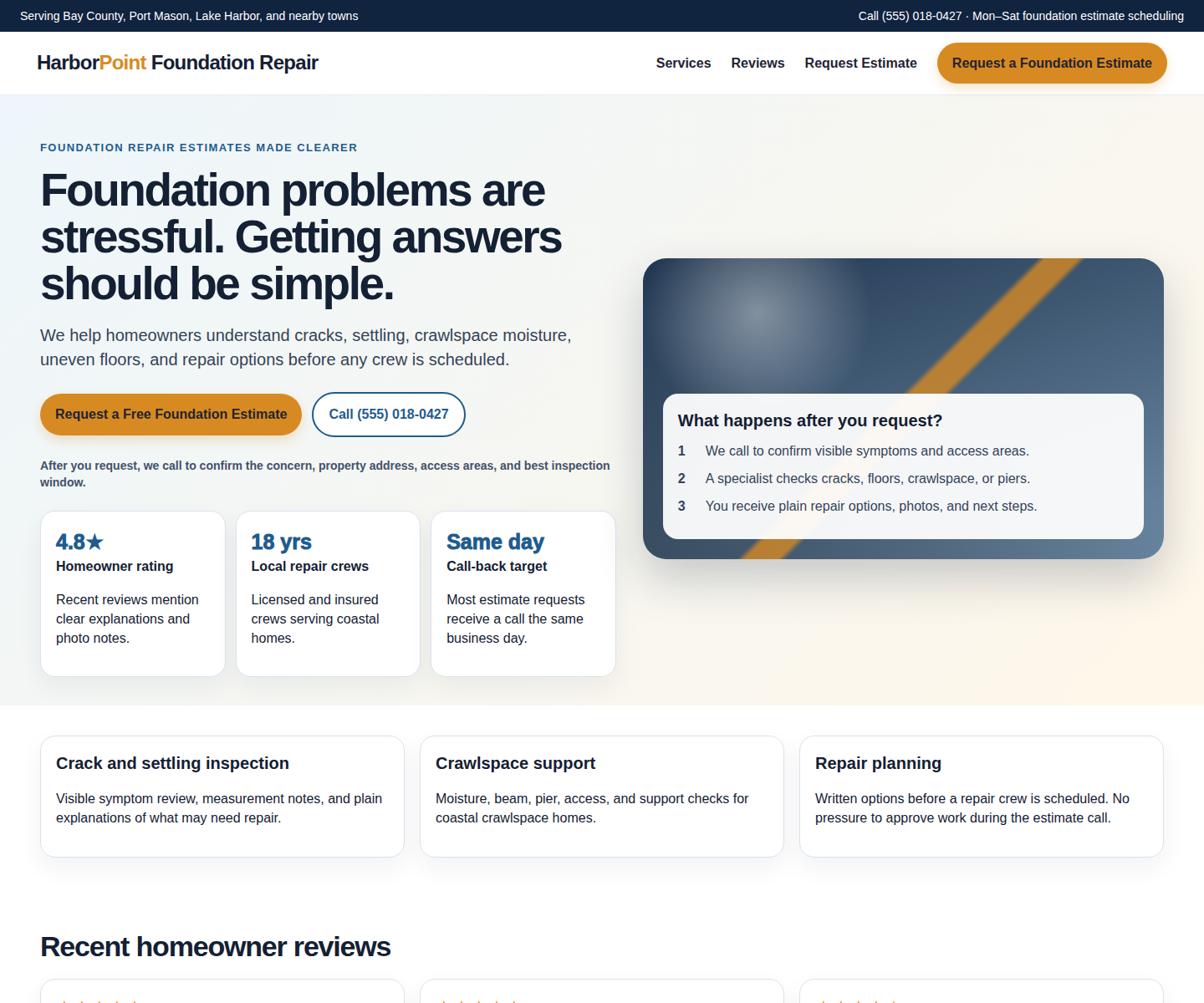
Visible evidence: foundation repair category, location box, Book Now, phone/contact path, rating/review reassurance, and foundation-repair positioning. Readable top-of-page crop shown here; full-page screenshot is retained in the evidence file.
Mobile homepage
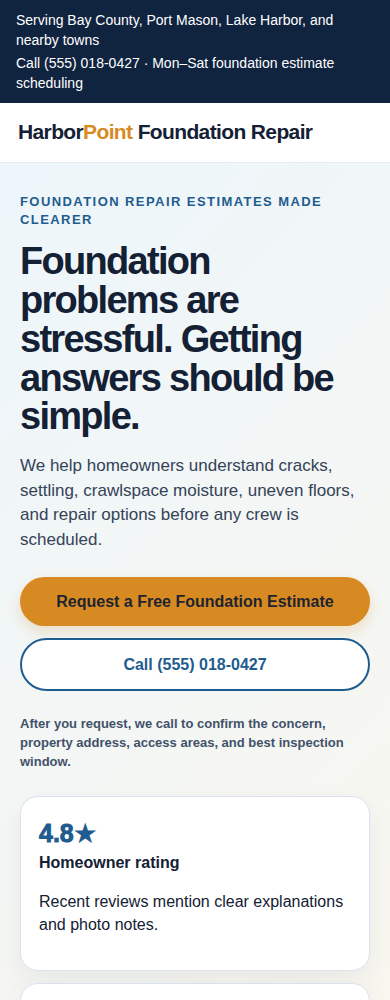
Visible evidence: Call Us, Book Now, Update location, and first-screen mobile decision area. The clipped review/rating line is a practical mobile confidence issue. Readable top-of-page crop shown here; full-page screenshot is retained in the evidence file.
Desktop services page
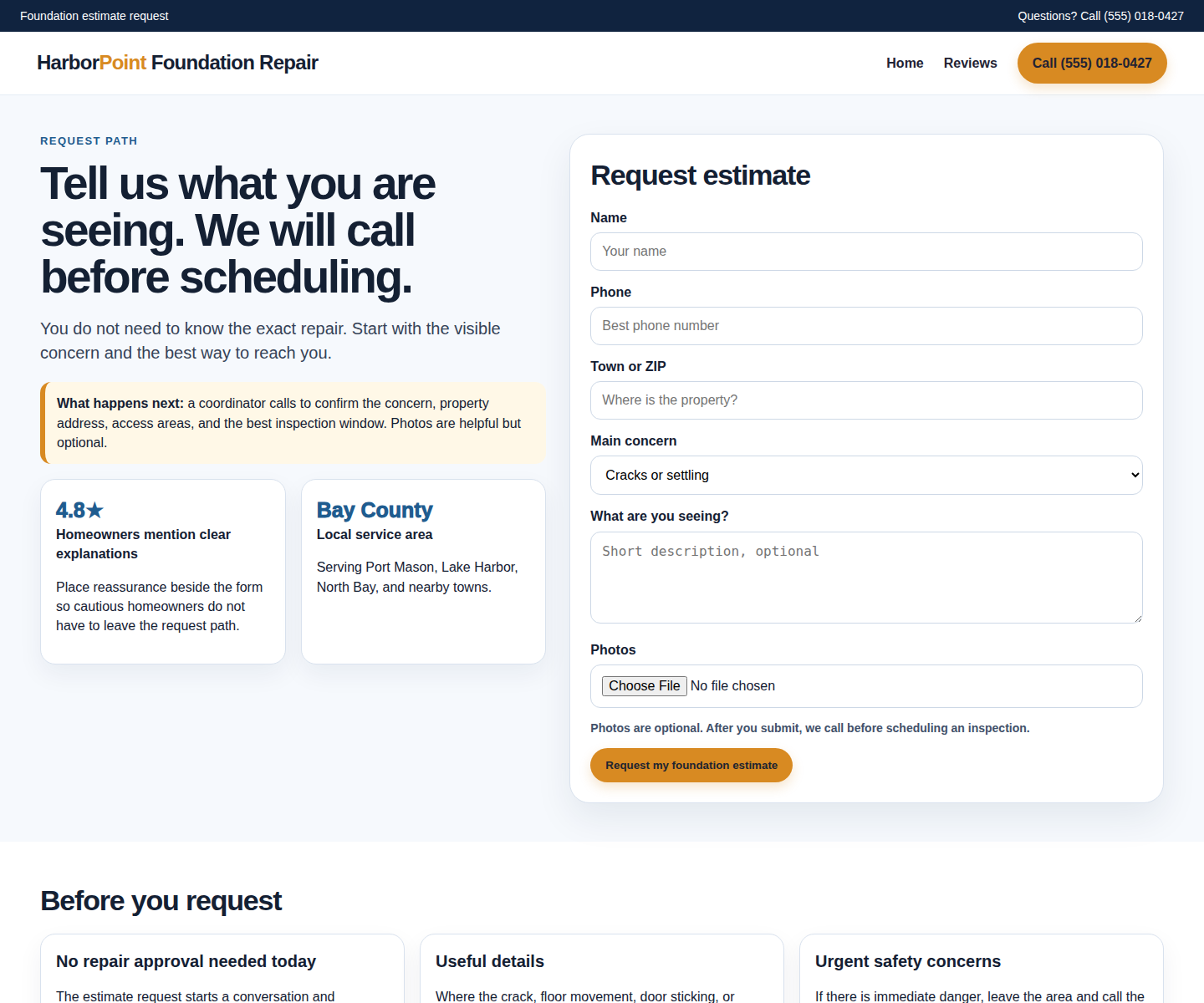
Visible evidence: Foundation repair Services page, local foundation repair service language, guarantee/reassurance, location/request action, and service context. Readable top-of-page crop shown here; full-page screenshot is retained in the evidence file.
Mobile services page
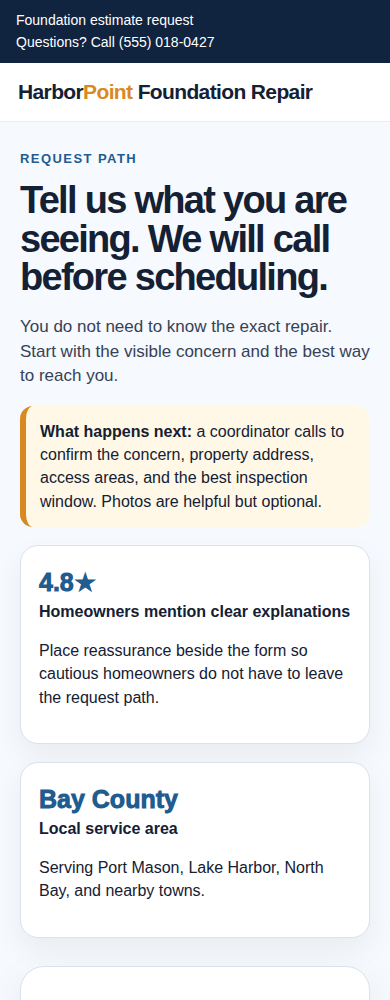
Visible evidence: mobile services flow and the amount of scrolling before detailed service reassurance appears. Readable top-of-page crop shown here; full-page screenshot is retained in the evidence file.
Competitor/reference: Local Foundation Specialist

Used only as competitor/reference context for call, booking, service-area clarity, and confidence placement. Not a ranking or sales claim. Readable top-of-page crop shown here; full-page screenshot is retained in the evidence file.
Competitor/reference: Crawlspace Moisture Contractor

Used only as competitor/reference context for call, booking, service-area clarity, and confidence placement. Not a ranking or sales claim. Readable top-of-page crop shown here; full-page screenshot is retained in the evidence file.
Competitor/reference: Regional Foundation Brand

Used only as competitor/reference context for call, booking, service-area clarity, and confidence placement. Not a ranking or sales claim. Readable top-of-page crop shown here; full-page screenshot is retained in the evidence file.
Competitor/reference: High-Review Local Contractor

Used only as competitor/reference context for call, booking, service-area clarity, and confidence placement. Not a ranking or sales claim. Readable top-of-page crop shown here; full-page screenshot is retained in the evidence file.
Competitor/reference: Urgent Repair Reference

Used only as competitor/reference context for call, booking, service-area clarity, and confidence placement. Not a ranking or sales claim. Readable top-of-page crop shown here; full-page screenshot is retained in the evidence file.
What we found and what to do next
What we found: Screenshot evidence has enough public evidence for a completed owner-facing recommendation. The finding below gives the current starting point, owner action, website-person task, verification check, and evidence limit.
- Evidence image grid: Evidence used: the screenshot grid and captions identify which desktop, mobile, service-page, or reference view supports the finding and what the owner should look at first.
- Caption: Evidence used: the screenshot grid and captions identify which desktop, mobile, service-page, or reference view supports the finding and what the owner should look at first.
- Scope boundary: Evidence limit: this uses visible public-page evidence only; no forms were submitted, no phone call or chat was opened, no outreach was sent, and no calls, bookings, sales, revenue, rankings, rating improvement, or legal result is promised.
- Owner action: Owner action: approve the main action, approved wording, and retest priority before the website person changes the public page.
- Acceptance check: How to verify: the same public-page view shows one primary action, a clear next-step explanation, source-safe reassurance, and no new clutter covering the decision.
Final owner summary
Final recommendation
Keep the strong brand, foundation repair category, contact findability, and reassurance. Improve the path by making one action primary, explaining the location/request step, moving confidence details closer to mobile action, and rechecking the same screens after edits.
Keep
Brand
Strong recognition and service context.
Fix first
Path
One action and one what happens next line.
Verify
Shots
Same desktop/mobile screenshots after edits.
Avoid
Claims
No rankings, calls, bookings, sales, or revenue promises.
What we found and what to do next
What we found: Final owner summary has enough public evidence for a completed owner-facing recommendation. The finding below gives the current starting point, owner action, website-person task, verification check, and evidence limit.
- What changed: Monthly rule: keep Month 1 as the starting point, compare the same pages and device views next month, and separate what changed from what remains open.
- What stayed open: Monthly rule: keep Month 1 as the starting point, compare the same pages and device views next month, and separate what changed from what remains open.
- Next month action: Owner action: approve the main action, approved wording, and retest priority before the website person changes the public page.
- No-guarantee boundary: Evidence limit: this uses visible public-page evidence only; no forms were submitted, no phone call or chat was opened, no outreach was sent, and no calls, bookings, sales, revenue, rankings, rating improvement, or legal result is promised.
- Owner action: Owner action: approve the main action, approved wording, and retest priority before the website person changes the public page.
- Acceptance check: How to verify: the same public-page view shows one primary action, a clear next-step explanation, source-safe reassurance, and no new clutter covering the decision.
Owner interpretation guide
The charts show the pattern and the interpretation gives the owner and website person the next practical decision. For HarborPoint Foundation Repair, the repeated decision is not whether the site has trust or service information — it does. The repeated decision is how quickly a mobile or homeowner with a foundation concern understands the next step before entering location, booking, calling, or choosing a service page.
Signal
What it means
What not to assume
Safe owner action
Strong brand/service findability
The site gives visitors enough reason to keep looking.
It does not prove more calls, bookings, rankings, or revenue.
Protect the brand and service clarity during edits.
location/request friction
The action is visible, but the visitor needs a clearer expectation before using it.
It does not mean the form is broken; no form was submitted.
Add one helper line and retest the same screens.
Mobile trust detail placement
Confidence details work best near the first action.
It does not justify unsupported review or rating promises.
Use source-safe, date-checked reassurance near action.
Competitor/reference pressure
Other pages may make action or emergency context easier to understand.
It is not a ranking comparison or sales evidence.
Borrow clarity patterns, not claims.
Monthly management interpretation
Level 3 needs to feel like a recurring owner dashboard, not a repeated one-time audit. Month 1 locks the starting point. Future months compare the same pages, same mobile/desktop views, same local-search areas, same competitor/reference set, and same issue tracker. That keeps changes meaningful instead of mixing different devices, cities, or screenshots.
| Monthly area | Month 1 starting point | What movement means | Owner decision rule |
|---|
| Call/book/contact recheck | Buttons and location/request actions are visible. | Improvement means one action becomes clearer without hiding useful secondary options. | Do not add more actions until the main action is obvious. |
| Local search findability snapshot | Track foundation repair inspection, foundation crack repair, crawlspace moisture repair, and local foundation repair terms with date/device/location notes. | Movement is only meaningful if the same method is used again. | Record changes, but do not call one search a ranking trend. |
| Competitor movement/watch | Accessible references show clarity patterns; blocked sites are excluded. | Movement means references change messaging, action placement, or reassurance pattern. | Adopt clarity patterns only when they fit the owner's service offer. |
| Review/rating freshness watch | Use visible source-safe confidence cues only. | Freshness matters because ratings and counts change. | Date-check before repeating a review/rating line. |
| Issue/action tracker | Primary open issues are location clarity, mobile confidence placement, and service-area wording. | Close only when screenshots prove the improvement. | Keep one top action per month so the owner can execute. |
The monthly checkup should never promise calls, bookings, rankings, sales, revenue, legal disability-access compliance, review removal, rating improvement, or reputation repair. Its value is practical findability: what changed, what improved, what got worse, what stayed flat, what stayed stuck, what to fix next, and how to verify it.
Monthly operating notes
The monthly report needs to become a rhythm the owner can understand quickly. It must not restart the entire audit each month. The same checks repeat so movement is meaningful: homepage first screen, mobile first screen, services page, location/request step, confidence placement, search/local snapshot, competitor/reference pattern, and issue/action tracker. New findings are useful only when they are compared against the same starting point.
Monthly decision
Evidence needed
What counts as improvement
What stays open
Main action clarity
Current desktop/mobile screenshots.
One action is visually and verbally primary.
Multiple equal-weight actions still compete.
Location/request clarity
Screenshot of the action area before submission.
Helper text explains why location is needed and what happens next.
Visitor still has to guess before entering information.
Mobile trust details
Phone screenshot around the first action.
Source-safe confidence line appears close to action.
Trust detail remains clipped, hidden, or too low.
Search/local findability
Same search phrases, city/device/location note, and date.
Page fit and service-area wording are clearer.
Different methods make comparison unreliable.
Competitor/reference watch
Accessible reference pages only.
Useful clarity pattern is identified and either adopted or rejected.
Blocked pages or irrelevant references are not used.
Each monthly report should end with a short owner decision: what to keep, what to fix next, what to watch, and what evidence will close the issue. That is the value of Level 3. It turns a website into an operating checklist without pretending that one report can guarantee calls, bookings, search rankings, sales, revenue, review improvement, or legal compliance.
Owner and website-person notes to prevent misread fixes
These notes are included because a visually strong report can still fail if the owner or website person misreads the action. The report is not asking the business to remove useful contact choices. It is asking the business to rank those choices. A homeowner with a foundation concern may prefer to call, book, or confirm local service by location. All three can remain available, but the first screen should make the safest recommended path obvious. Secondary actions should support the decision instead of competing with it.
The helper copy needs to be short and placed before the visitor has to act. For example, the Location/request explanation must not appear after the location box. It should sit beside or just under the location box so the visitor knows why the information is needed. The copy should avoid overpromising. It must not say that entering location guarantees availability, immediate dispatch, a specific arrival window, a discount, a booking, or a result. It should only explain the next step plainly.
Confidence details need to be source-safe and close to the decision point. If a rating, review count, guarantee, or inspection-timing promise is used, it needs to be visible on the report date or approved by the owner. If the source changes, the wording needs to be checked again. The practical website goal is not to stuff more trust details onto the page. The goal is to put one believable reassurance line where it reduces hesitation before the visitor calls, books, or starts the request.
Search and local presence notes should stay owner-readable. The report includes title, heading, behind-the-scenes search basics, Google Business listing alignment, and tracked searches, but it should translate those terms into plain business decisions: does the page clearly say the service, does it clearly say the area, does the profile match the site, and can the same checks be repeated next month? This avoids turning the report into a technical Google/search dump while still covering the promised local-search work.
Competitor/reference comparisons need to be used carefully. A competitor page may show a cleaner emergency message, simpler booking path, clearer service-area wording, or stronger first-screen reassurance. That is useful. It does not prove the competitor ranks higher, gets more calls, books more jobs, or has better customers. The safe use is to compare page patterns, choose what fits HarborPoint Foundation Repair, and reject anything that would add clutter, unsupported claims, or confusion.
Acceptance checks matter more than opinions. A fix is not complete because the page looks better to the website person. It is complete when the same desktop and mobile screenshots show the intended improvement: one action is visually primary, location/request is explained before data entry, the service/category is clear, one confidence detail is close to the decision point, and no new clutter hides the visitor path. If those screenshots do not prove the change, the issue stays open.
Final execution guardrails
The safest way to use this report is to make a small number of visible changes, then verify them with screenshots. The owner needs to not treat the report as a reason to rebuild the full website, add a new marketing stack, change pricing, promise faster service, or create new claims. The report is narrower and more useful than that. It identifies where a public visitor may hesitate before taking the next step, then turns that into a controlled set of website changes.
The website person needs to preserve what is already working: recognizable brand, foundation repair service fit, phone/contact findability, local service availability, and visible confidence details. The website person needs to improve what creates friction: unclear location/request purpose, competing first actions, mobile trust detail placement, and service-area wording that appears too late. Those changes are practical, reversible, and easy to verify.
The owner needs to approve wording before it goes live. Approved wording needs to be plain, short, and safe. It should explain the next step without guaranteeing availability, response time, dispatch, calls, bookings, rankings, sales, revenue, review improvement, or legal/easy-to-use/readability compliance. If the owner wants to use stronger claims, those claims need separate source evidence and approval outside this report.
The final check needs to be visual. Open the homepage and services page on desktop and phone. Confirm the main action is obvious, the location/request step is explained, the service fit is clear, confidence is near the action, and no sticky/floating element covers important copy. If those checks pass, the item can move into the next monthly starting point. If any check fails, keep the issue open and revise the page instead of calling the fix complete.
Screenshots used in this analysis
Desktop homepage
Visible evidence: foundation repair category, location box, Book Now, phone/contact path, rating/review reassurance, and foundation-repair positioning. Readable top-of-page crop shown here; full-page screenshot is retained in the evidence file.
Mobile homepage
Visible evidence: Call Us, Book Now, Update location, and first-screen mobile decision area. The clipped review/rating line is a practical mobile confidence issue. Readable top-of-page crop shown here; full-page screenshot is retained in the evidence file.
Desktop services page
Visible evidence: Foundation repair Services page, local foundation repair service language, guarantee/reassurance, location/request action, and service context. Readable top-of-page crop shown here; full-page screenshot is retained in the evidence file.
Mobile services page
Visible evidence: mobile services flow and the amount of scrolling before detailed service reassurance appears. Readable top-of-page crop shown here; full-page screenshot is retained in the evidence file.
Competitor/reference: Local Foundation Specialist
Used only as competitor/reference context for call, booking, service-area clarity, and confidence placement. Not a ranking or sales claim. Readable top-of-page crop shown here; full-page screenshot is retained in the evidence file.
Competitor/reference: Crawlspace Moisture Contractor
Used only as competitor/reference context for call, booking, service-area clarity, and confidence placement. Not a ranking or sales claim. Readable top-of-page crop shown here; full-page screenshot is retained in the evidence file.
Competitor/reference: Regional Foundation Brand
Used only as competitor/reference context for call, booking, service-area clarity, and confidence placement. Not a ranking or sales claim. Readable top-of-page crop shown here; full-page screenshot is retained in the evidence file.
Competitor/reference: High-Review Local Contractor
Used only as competitor/reference context for call, booking, service-area clarity, and confidence placement. Not a ranking or sales claim. Readable top-of-page crop shown here; full-page screenshot is retained in the evidence file.
Competitor/reference: Urgent Repair Reference
Used only as competitor/reference context for call, booking, service-area clarity, and confidence placement. Not a ranking or sales claim. Readable top-of-page crop shown here; full-page screenshot is retained in the evidence file.
Final delivery scope
Work basis: public pages were checked from visible website evidence only. No forms were submitted, no phone call was made, no chat was opened, and no outreach was sent. This report does not guarantee calls, bookings, sales, revenue, rankings, legal disability-access compliance, review removal, rating improvement, or reputation repair. Findings are owner-facing plain-English notes based on what was visible at check time.
The report is intended to help the owner and website provider decide what to change first, how to verify it, and what to monitor next month. It is not a public ranking, customer behavior evidence, legal conclusion, or revenue forecast.